
By Neftali Serrano, PsyD
Far too often, I hear the same weary refrain from healthcare professionals championing integrated care:
“My leaders tell me that my integrated care program is just not making us enough money.”
Let’s be clear—this isn’t a financial question. It’s a philosophical one dressed up in a spreadsheet. Because when a leadership team says that, what they’re really saying is:
“We think behavioral health is optional in primary care.”
But it isn’t. And saying it is means you’re no longer offering primary care. You’re offering something else. And maybe it’s time we call it what it is:
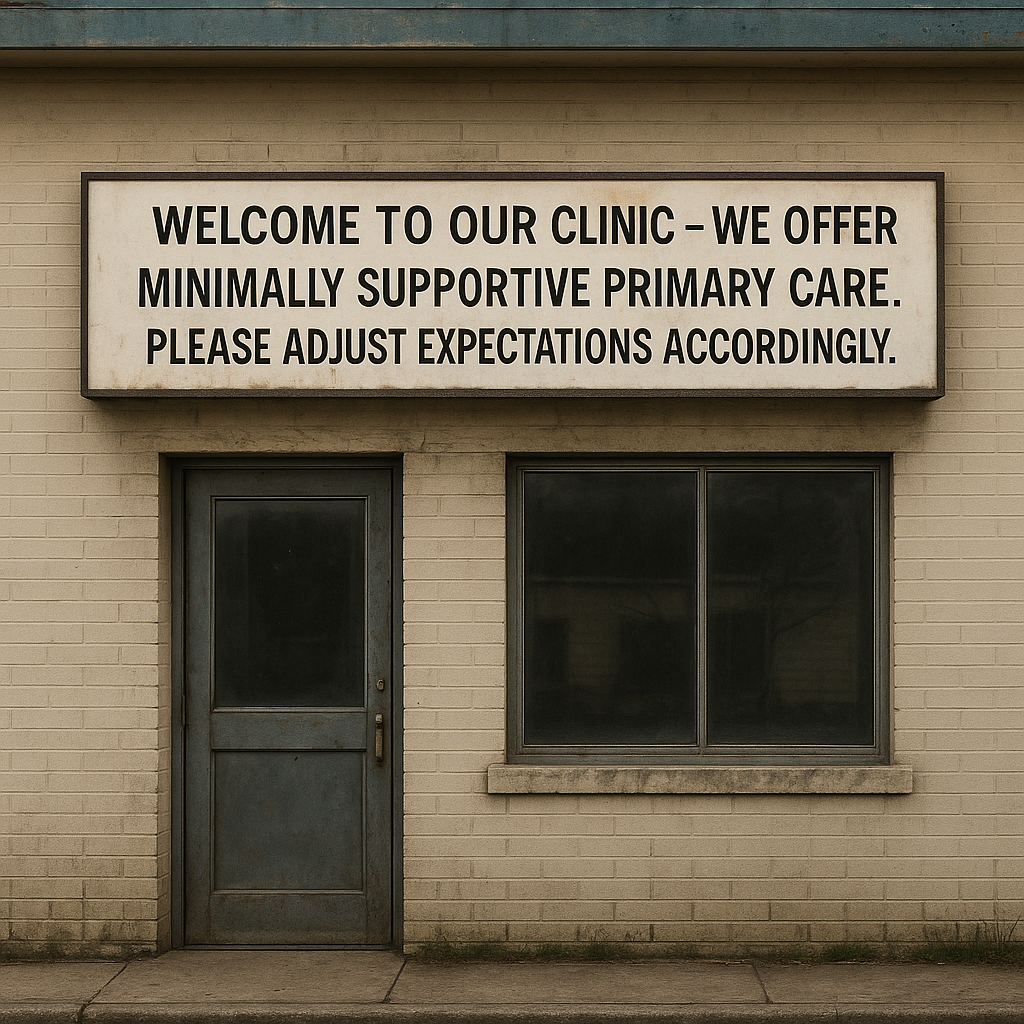
Minimally Supportive Primary Care (MSPC™).
MSPC: A New Label for a Lower Standard
Just like we’ve coined terms like “Advanced Primary Care” and “Team-Based Care” to describe what happens when we integrate services around patients’ whole health, we now need a term for the opposite—when systems undercut a core function of care.
Minimally Supportive Primary Care is what you have when behavioral health is seen as an “ancillary” service instead of a foundational one. It’s the kind of care that says:
- Emotional distress? Here’s a referral… good luck.
- Health behavior change? We’ll mention it… once.
- Chronic illness + depression? Let’s just focus on the labs.
It’s short-sighted leadership that either hasn’t spent any time in an exam room or has spent enough time behind a desk that they have forgotten that every moment of every day in a primary care clinic, behavior is at the center of conversations between patients and their providers of care.
Reframing the Conversation
Instead of asking, “How can we support this extra service?” leadership teams must ask:
“How will we financially sustain the behavioral health function of our primary care services?”
Behavioral health is not optional because behavior is the scaffolding of health. Medication adherence, health habits, supporting mental health, and managing chronic disease—these are behavioral tasks. And if we fail to support those, we fail at primary care. Full stop.
So, if you’re thinking of cutting or underfunding integrated care, then as a responsible leader, you must do one of two things:
- Show us your alternative plan for embedding behavioral support into your care model (spoiler: most don’t have one),
- Or, be transparent with your patients and payers and adopt the MSPC label. Let’s stop pretending.
The Cost of Cutting Corners
Let’s also be honest about what MSPC costs you:
- More ER visits.
- Higher rates of avoidable hospitalizations.
- Lower quality scores.
- Frustrated providers.
- Worsening inequities.
And yet, programs are judged solely on their own direct billing, ignoring the systemic value they create and the core function they serve. That’s like judging the worth of your plumbing by how much water the pipes sell.
A Challenge to Leaders
If you want to be in the business of primary care, then you’re in the behavior business. And that means integrated care is not a side hustle. It’s the operating system.
So here’s a shift in mindset: stop looking for ROI in the BH line item. Start looking at the downstream impact of behavioral health functions well-executed: clinical outcomes, provider retention, quality bonuses, patient satisfaction, and access equity. That’s where the real money is. And stop thinking about integrated care as its own service line. Various members of your team are involved in supporting behavior change, not just the ones you designate as being in “integrated care.” Your PCPs and nurses are just as involved in supporting behavior change in your clinics as are your mental health specific personnel.
This BTW does not mean that personnel on your teams with behaviorally-loaded responsibilities get to avoid scrutiny or skirt responsibilities for demonstrating value. It does mean that as a leader you are responsible for the vision of your services, so if you exercise scrutiny you must do so from the context of a vision for the behavioral health function of primary care. Or, as I argue above, be honest with payers and patients alike that what they are getting from your clinics is what it is.
Quick Messaging for Advocates
To help you navigate these conversations, try these short prompts:
- “What’s your plan for addressing the behavioral health function of your primary care if not through integrated care?”
- “Are we willing to tell patients and payers we’ve opted for Minimally Supportive Primary Care?”
- “Instead of cutting an integrated care program, can we build a sustainable model that protects our primary care integrity?”
Final Thought
This isn’t about funding a service. It’s about funding a function. If we believe in whole-person care then the finances must follow the philosophy. Otherwise, we need to stop pretending and update our signage:
Welcome to Our Clinic – We Offer Minimally Supportive Primary Care. Please Adjust Expectations Accordingly.
Let’s stop apologizing for integrated care. Let’s start demanding that primary care be primary in every sense.

Leave a Reply