
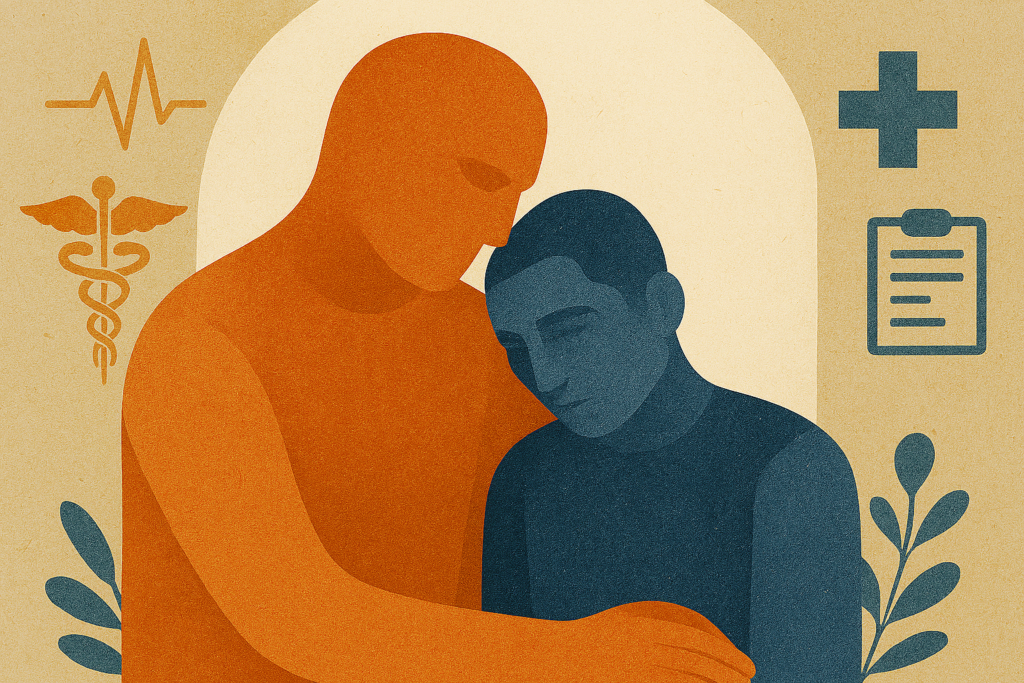
Marcus is a 40‑year‑old African American man whose primary care provider (PCP) recently noted significant changes in mood following his ALS diagnosis two months ago. During several follow‑up appointments, the PCP observed that Marcus appeared less engaged, showed diminished interest in life, and expressed overwhelming concern about what the progression of the disease might mean for him. When the PCP explored these changes further, Marcus shared that he felt consumed by the news of his health and as though all hope had been lost. After this conversation, the PCP consulted the on-call Behavioral Health Provider (BHP) to explore opportunities for additional support as Marcus navigates the impact of his diagnosis.
This example reflects the juncture at which we often meet our clients. Moments when patients are confronting some of the most challenging experiences of their lives. Our task as BHPs is to work collaboratively across treatment teams to establish a care plan for patients like Marcus and others facing similar circumstances.
Working alongside patients, families, and providers is one of the most invigorating aspects of being a systemically oriented clinician. In my work teaching and supervising students to work in integrated care settings, I consistently encourage them to recognize both the immense privilege and the profound responsibility of working with individuals, couples, and families in this role. We meet people as they grapple with the immediate and long‑term implications of a new diagnosis. As systemically oriented providers in healthcare, this is precisely where we are meant to be.
When cases like Marcus’s are presented to students, they often pause at the weight of the circumstance. Learning that a client has a chronic condition that may significantly shorten their lifespan can shift a student’s focus solely to the individual and their current symptoms. How do we treat the low mood? What brief intervention is most useful right now? While these questions are valid and necessary, I also guide them toward a broader systemic lens. What do we know about Marcus’s family system? Who else is being impacted by this illness experience? How are they—Marcus included—making sense of the diagnosis and its long‑term implications? How might the healthcare team support this system as it navigates the unfolding journey? Expanding their vantage point deepens their conceptualization and shifts their approach to treatment planning.
In these moments, I encourage students to see both the client and their family as occupying a space where uncertainty, frustration, hope, and curiosity coexist. There is often a stark contrast between the emotional heaviness of chronic illness and the high‑speed pace of medical environments. While the medical system may feel unable to slow down, our role is to collaborate with the team to pause long enough to share the weight the family carries.
With this in mind, we return to Marcus and his visit with the BHP.
When the BHP meets with Marcus, they learn that he is a single father to Aaron, his 13‑year‑old son, with whom he shares a close relationship. Marcus’s wife died from complications during childbirth, and since then, his extended family has played a significant role in supporting him and Aaron. Although Marcus has not yet experienced major physical symptoms, he admits that the lack of visible decline has allowed him to delay disclosing his diagnosis. During the visit, he voices the questions that have been quietly consuming him:
How will this illness progress? Who will care for my son if my life is shortened? Is this condition genetic? Could my son face this one day?
These are the moments where the expertise of the BHP and PCP converge. Discussing cases like this with students allows them to witness the point at which a patient’s biomedical understanding of their health meets their lived reality and where the implications extend far beyond the exam room. In this teachable moment, students are invited to engage in systemic thinking. What is their role in supporting Marcus as he makes sense of his illness and determines the appropriate timing for disclosure? How might other providers on the care team offer clarification and support as Marcus works to understand what comes next?
As systemically oriented Behavioral Health Providers, we create space for true collaboration. We help families navigate the timing and process of disclosure. We coordinate with the broader healthcare team. We work with patients to prepare relationally focused questions for physicians. Questions about how the illness may affect intimacy, how dietary changes may create tension at home, or how fatigue may alter parenting roles. We highlight the multidimensional facets of a patient’s experience, helping the interdisciplinary team see the patient as a whole person embedded within a larger system.
However, this work requires an infrastructure that supports it. To provide optimal holistic care, we must ask ourselves: How do our health systems support systemic work? What does shared information look like across teams? To truly navigate the experience of illness, we must offer resources across three interconnected fronts:
- The Patient: Tools to navigate the internal emotional experience of illness.
- The Family: Support for caregivers who carry the secondary weight of the diagnosis.
- The System: Collaboration that accommodates the relational and logistical challenges of long‑term health management.
By bringing the family system back into focus, we give our patients the best opportunity to navigate the complex journey of health and healing together.
The case presented is fictional and is based on several cases encountered by the writer.

Leave a Reply